“Isn’t winter camping just too cold?” A lot of people give up on the idea for exactly that reason. Will I be able to sleep at night? Can I drive on snowy roads? It’s easy to come up with plenty of worries.
But here’s the thing: winter is when Mt. Fuji looks its most beautiful all year, and campsites are less crowded. It’s a truly special season. With the right gear and preparation, it can become a trip where you think, “I’m so glad we came in winter.” Even if you’ve never experienced snow or below-freezing temperatures, reading through this article once will tell you everything you need to prepare.
 Point
Why winter with CLOUD NINE is worry-free
- In winter, every vehicle comes with a kerosene heater, an electric blanket, sleeping bags and a portable power station for free (no extra charge)
- From December 1 to March 31, all vehicles have studless winter tires
- If a heavy snow warning or similar, a road closure, or chain restrictions might make you late for the return, just contact us before your scheduled return time (16:00) and you won’t be charged anything for the delay
- If you need help, you can message us on Instagram or LINE (you’ll exchange contact details with our staff on the day of rental, and any language is fine)
 Contents
- What’s so great about winter camping?
- How cold does it get in winter?
- What gear comes with the car in winter?
- How do I use the kerosene heater?
- How do I use the electric blanket?
- How can I stay warm at night?
- Is it OK to come with kids?
- Can I drive when it snows?
- What kind of campsite should I choose in winter?
- What should I bring?
- Frequently Asked Questions
- Summary and how to book
 Already booked? Read these sections before you go
What’s so great about winter camping?
You might be surprised, but winter is a very popular season at CLOUD NINE CAMPING JAPAN. As long as you’re properly prepared for the cold, you can enjoy scenery and peace and quiet that only winter can offer.
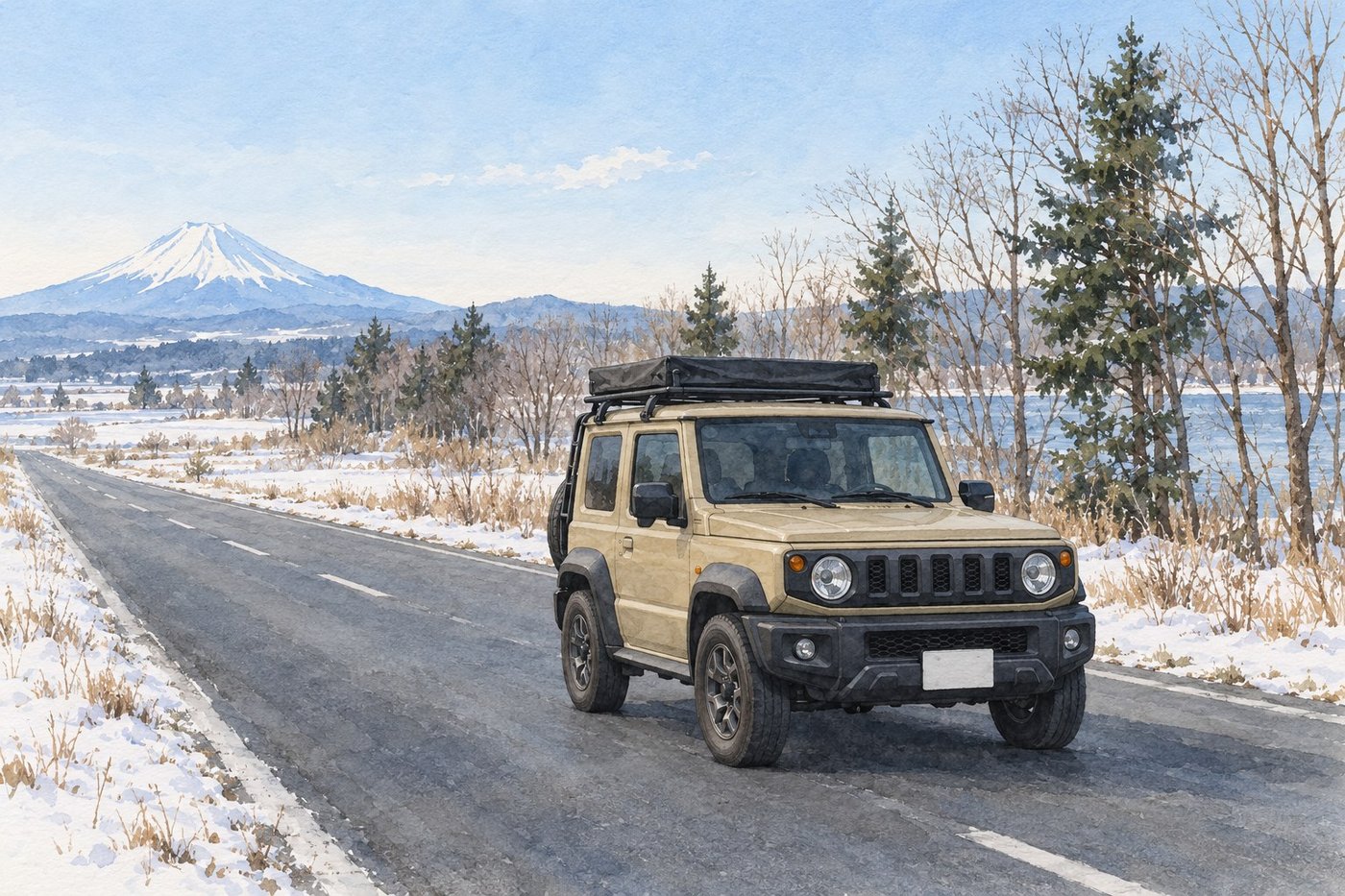
Highlight 1: You can see snow-capped Mt. Fuji
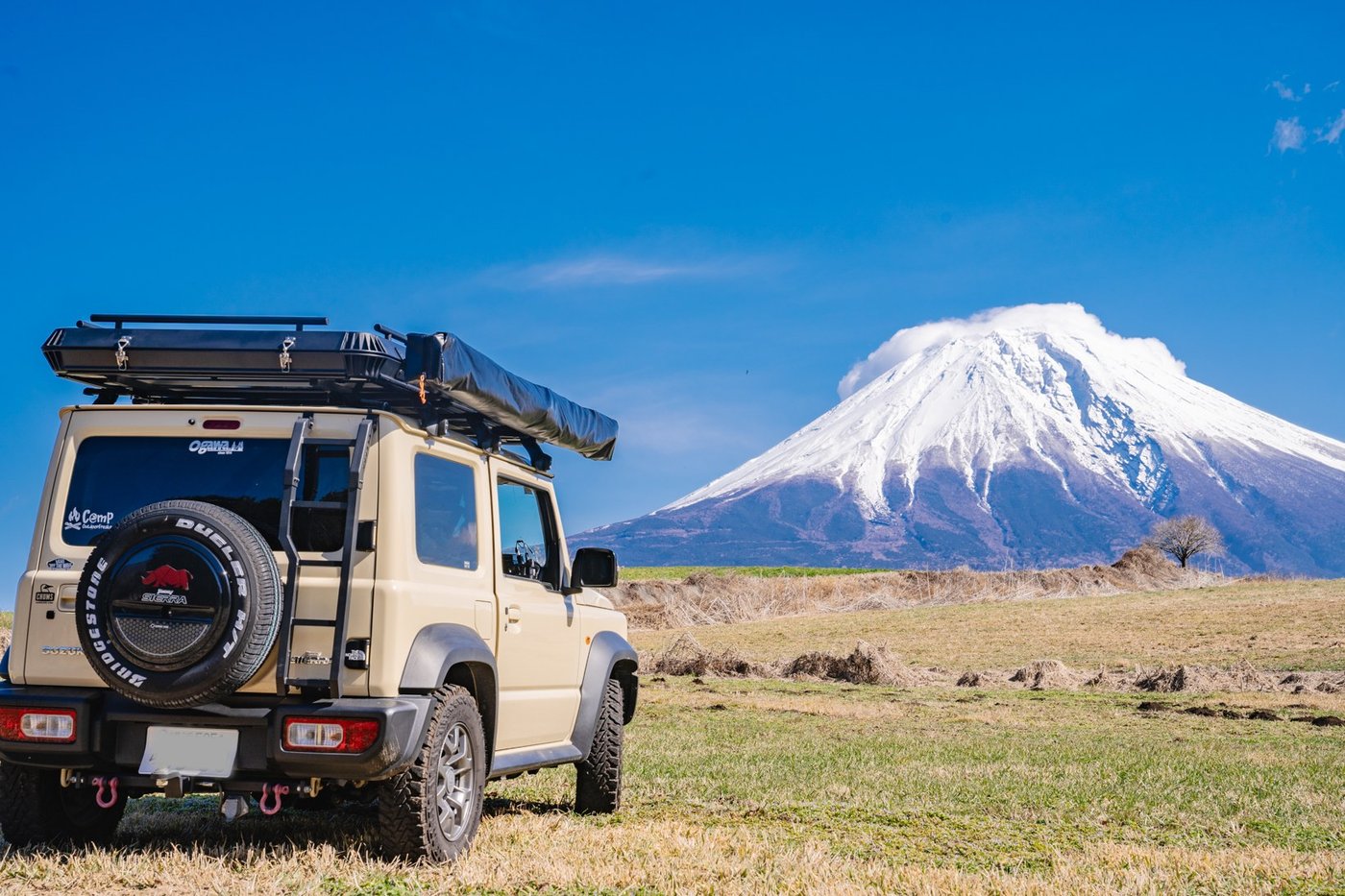
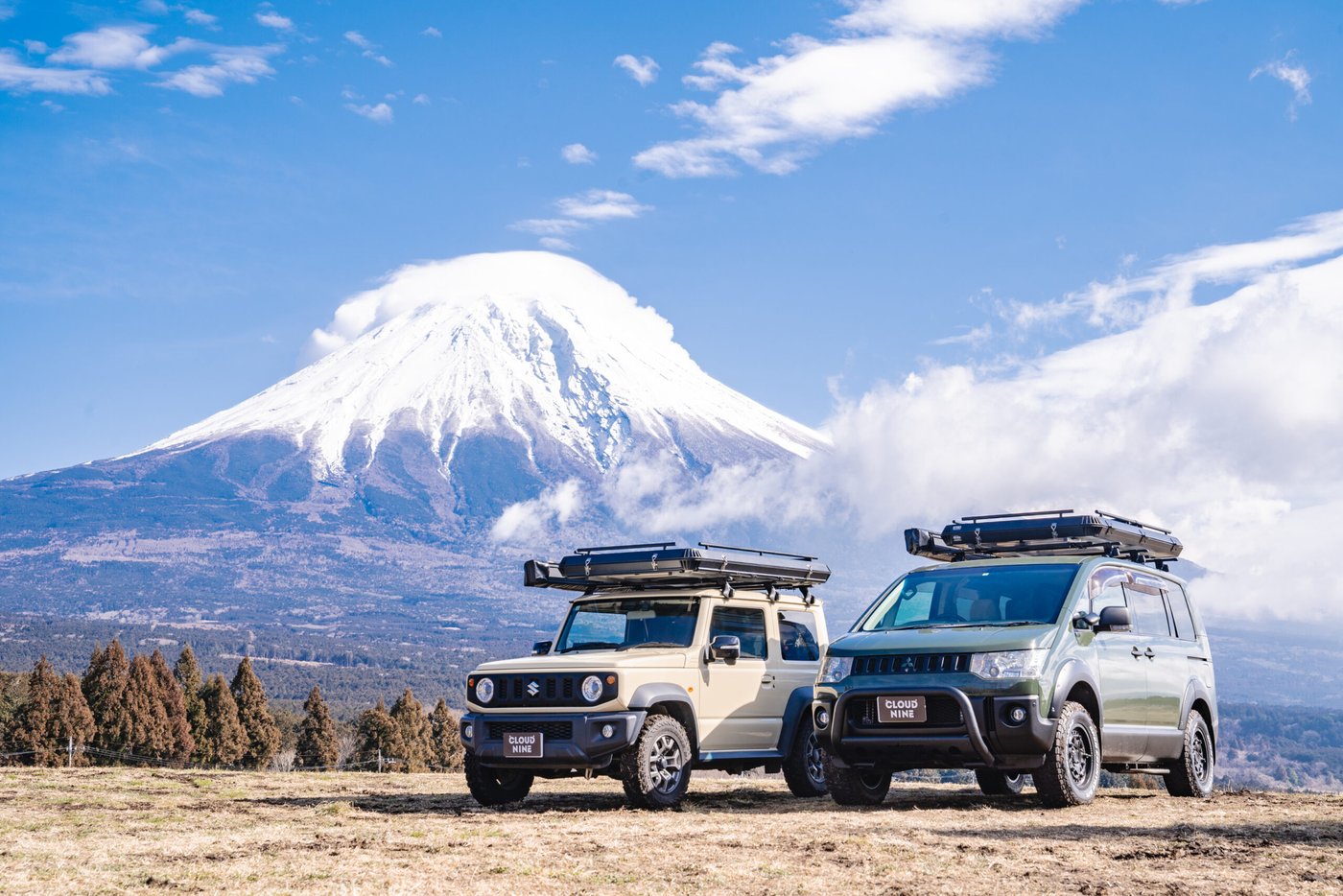
The biggest highlight of winter is getting to see snow-capped Mt. Fuji. The “Mt. Fuji with a white top” you’ve probably seen in photos and paintings is a look that only this season brings.
Snow usually starts to cover Mt. Fuji around October (the first snowcap of the season, when snow is first seen on the summit, comes on October 2 in an average year). In some years, it doesn’t happen until November. The snow stays until spring, so you can enjoy snow-capped Mt. Fuji until around May.
Winter in particular has crisp, clear air, which makes it the season when snow-capped Mt. Fuji is most likely to look its sharpest. Imagine poking your head out of the tent in the morning and seeing a pure-white Mt. Fuji right in front of you. Moments like that are what winter camping is all about.
Highlight 2: Almost no bugs
In summer, campsites surrounded by nature have lots of beetles, mosquitoes, horseflies, black flies and other bugs, so bug spray and other protection are a must.
In winter, there are almost none of these bugs. You can relax without worrying about bug spray or mosquito coils. If you don’t like bugs, you could even say this is the most comfortable season of the year.
Highlight 3: Starry skies and quiet campsites
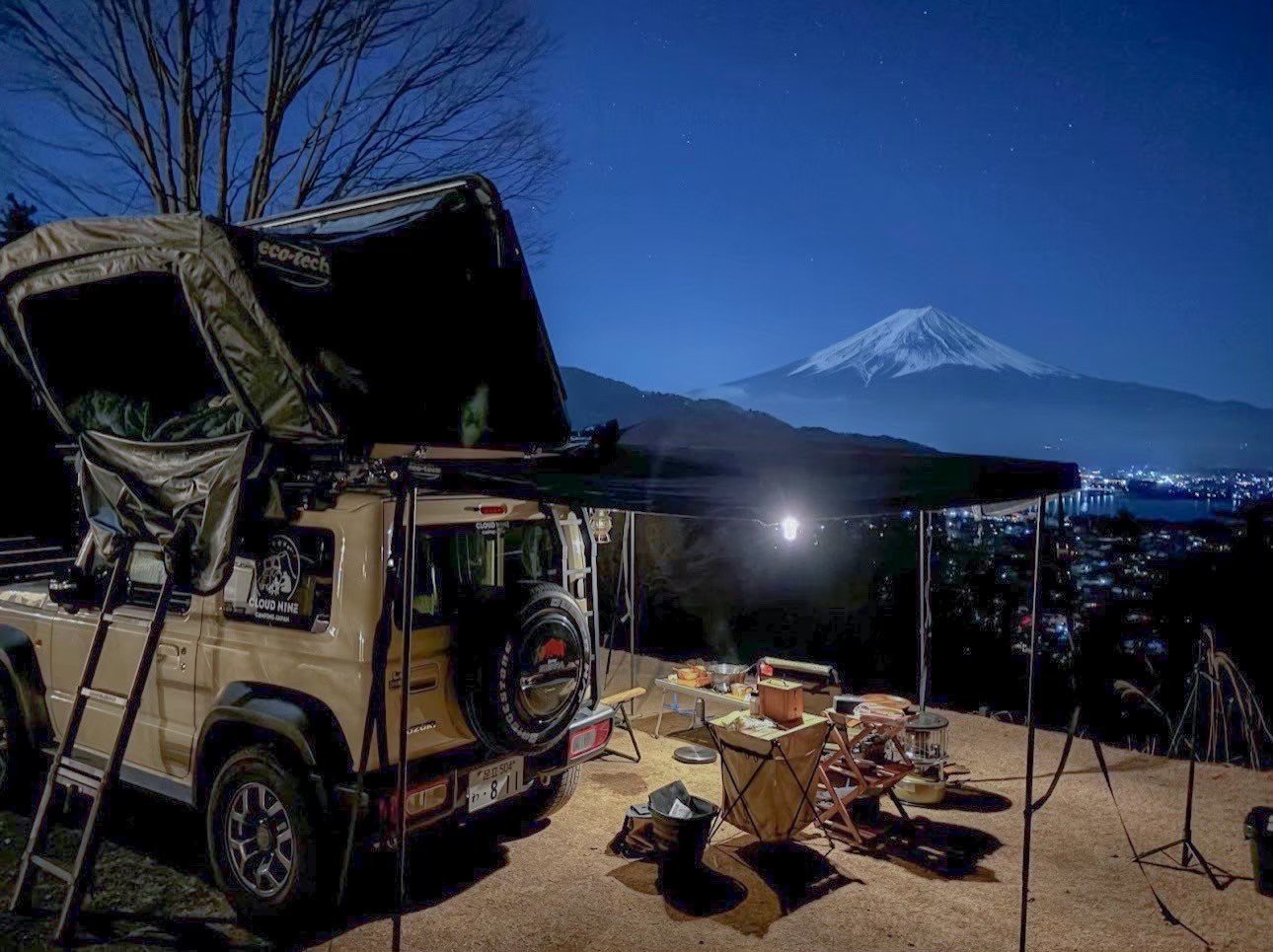
After sunset, if your campsite is away from city lights, you can enjoy a sky full of stars. Gazing up at the stars while warming up by the kerosene heater is a luxury unique to winter camping.
Compared with spring, summer or the autumn-leaf season, even popular campsites are less crowded, so you can take your time and relax.
How cold does it get in winter?
Here are the average temperatures in the Mt. Fuji area (Lake Kawaguchi) over the last five seasons (December 2021 – March 2026), based on Japan Meteorological Agency observation data.
| Month | Daytime high | Overnight low |
|---|---|---|
| December | 9.4°C | −3.0°C |
| January | 6.8°C | −5.4°C |
| February | 7.7°C | −4.4°C |
| March | 12.3°C | 0.3°C |
From December to February, daytime temperatures are around 7–9°C, so on a sunny day you won’t feel too cold while you’re moving around. At night, though, temperatures drop below zero, and in January, the coldest month, the average low is in the −5°C range. At −5°C, it isn’t as cold as the inside of a freezer, but if you stand outside, your hands will start to go numb. “The daytime is more comfortable than you expected, but the moment the sun goes down, it gets cold fast” — that’s what winter in the Mt. Fuji area feels like. For what to wear, see “What should I bring?”.
What gear comes with the car in winter?
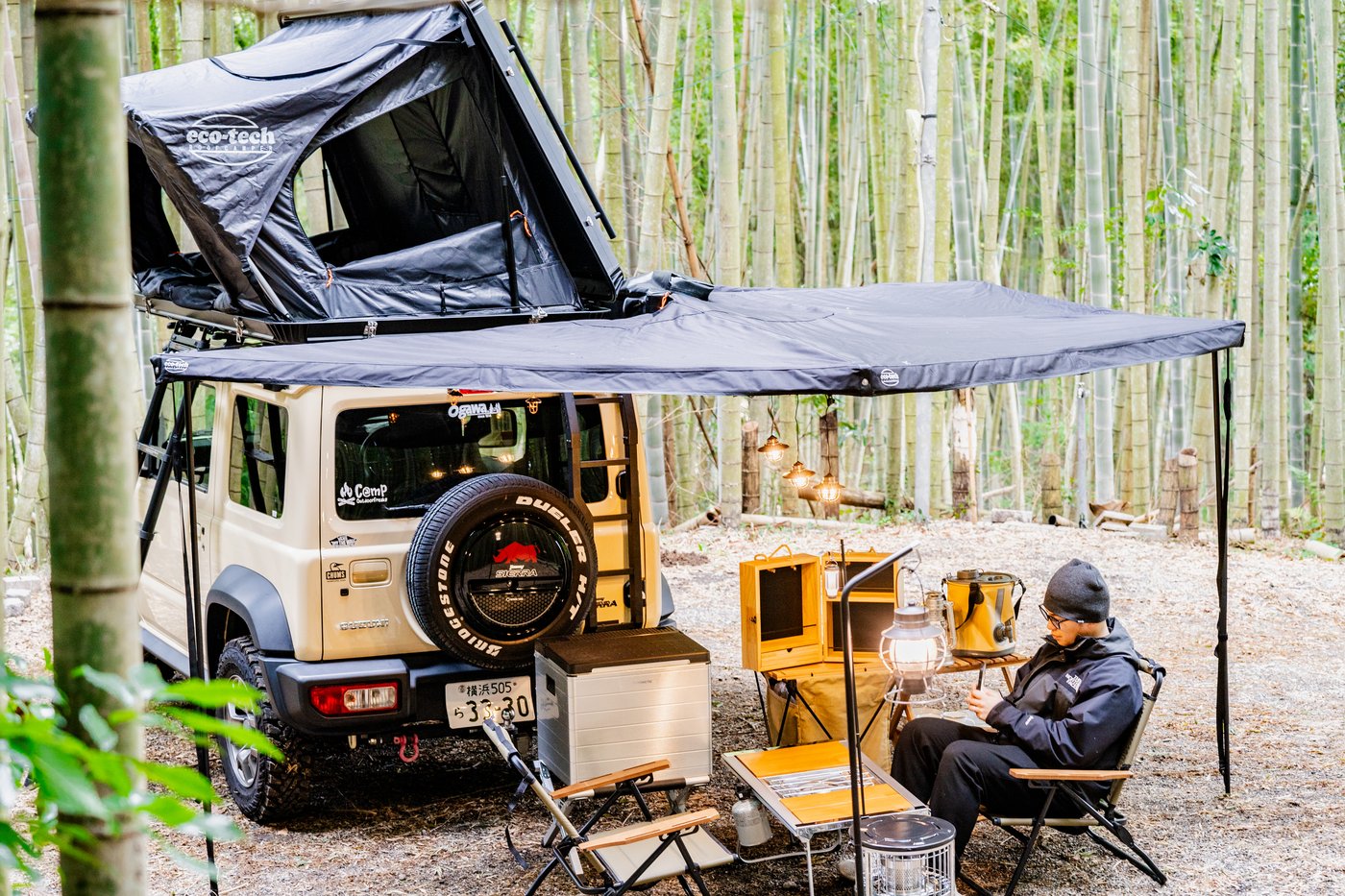
“Can I really stay warm camping with a rental car?” We get this question a lot, especially in winter. The answer is yes, you can. During the winter season, every vehicle is equipped with gear to keep you warm.
Free gear
| Gear | Details |
|---|---|
| Studless tires | Fitted on all vehicles from December 1 to March 31 |
| Kerosene heater | Included in every vehicle in winter. A full 5 L tank of kerosene lasts up to about 18 hours. You can also boil water on top. For outdoor use only. Do not use it inside the tent or inside the car |
| Electric blanket | One per vehicle. Lay it under your sleeping bag |
| Wind-blocking awning wall | A side panel that attaches to the car side awning (the roof on the side of the car). It attaches with Velcro and the bottom is secured with pegs |
| Sleeping bag (Coleman) | The manufacturer’s stated comfort temperature is −5°C |
| Portable power station (EcoFlow, approx. 1,000Wh) | Included in every vehicle. Enough to charge a smartphone about 50–60 times |
Paid options
| Option | Price |
|---|---|
| Heated vest (with a 20,000mAh mobile battery) | ¥500 per day (excl. tax) |
| Extra kerosene (10 L) | ¥1,800 (excl. tax) |
Paid options cannot be booked online, so please ask our staff on the day of rental.
What’s a heated vest?
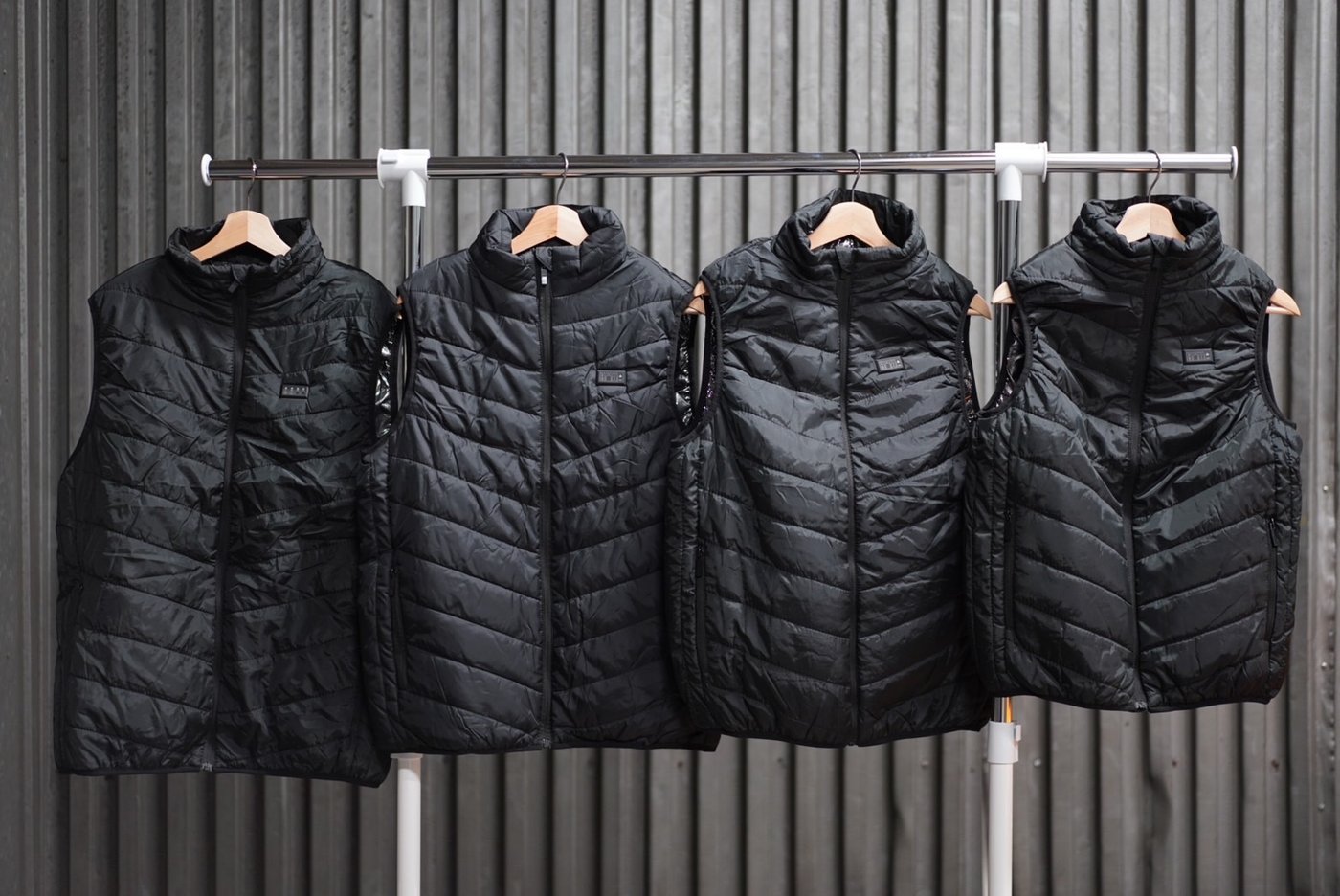
If you’d like an easier way to keep your body warm, we also offer heated vests. You can rent one for ¥500 per day (excl. tax), and it comes with a 20,000mAh mobile battery (the battery goes in the vest’s inside pocket).
The vest warms your abdomen, back and shoulders, and comes in sizes S, M, L, XL and 2XL (no children’s sizes). Because it keeps you warm without using the car’s portable power station, it’s especially recommended if you “don’t want to use too much power on the electric blanket” or “want an easy way to stay warm while sightseeing during the day.”
How do I use the kerosene heater?
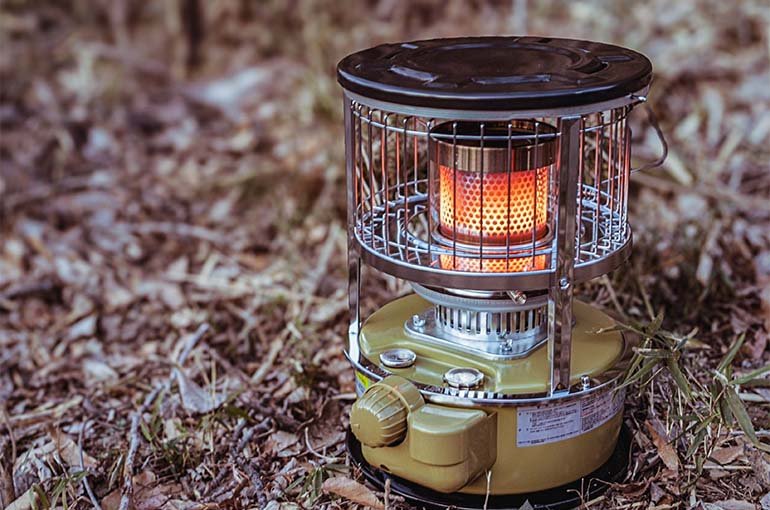
CLOUD NINE’s kerosene heater is an outdoor-only model from a brand called PASECO. It runs on kerosene (灯油, touyu in Japanese). During winter, every vehicle has one, and we hand it over with a full tank. It has an automatic shut-off that puts out the flame if the heater tips over or is shaken.
How long does it last?
With a full 5 L tank of kerosene, it lasts up to about 18 hours.
Can I boil water on it?
Yes. You can put a kettle on top of the heater and boil water. Sipping a hot drink while you relax is one of the best parts of winter camping.

What if I run out of kerosene?
Take the heater itself to a nearby gas station and tell the staff “灯油 (TOUYU),” and they’ll fill it up for you. If buying more on the road sounds like a hassle, we also offer an extra 10 L of kerosene as an option (¥1,800 excl. tax; please ask on the day of rental).
A trick to keep the heater’s warmth from escaping
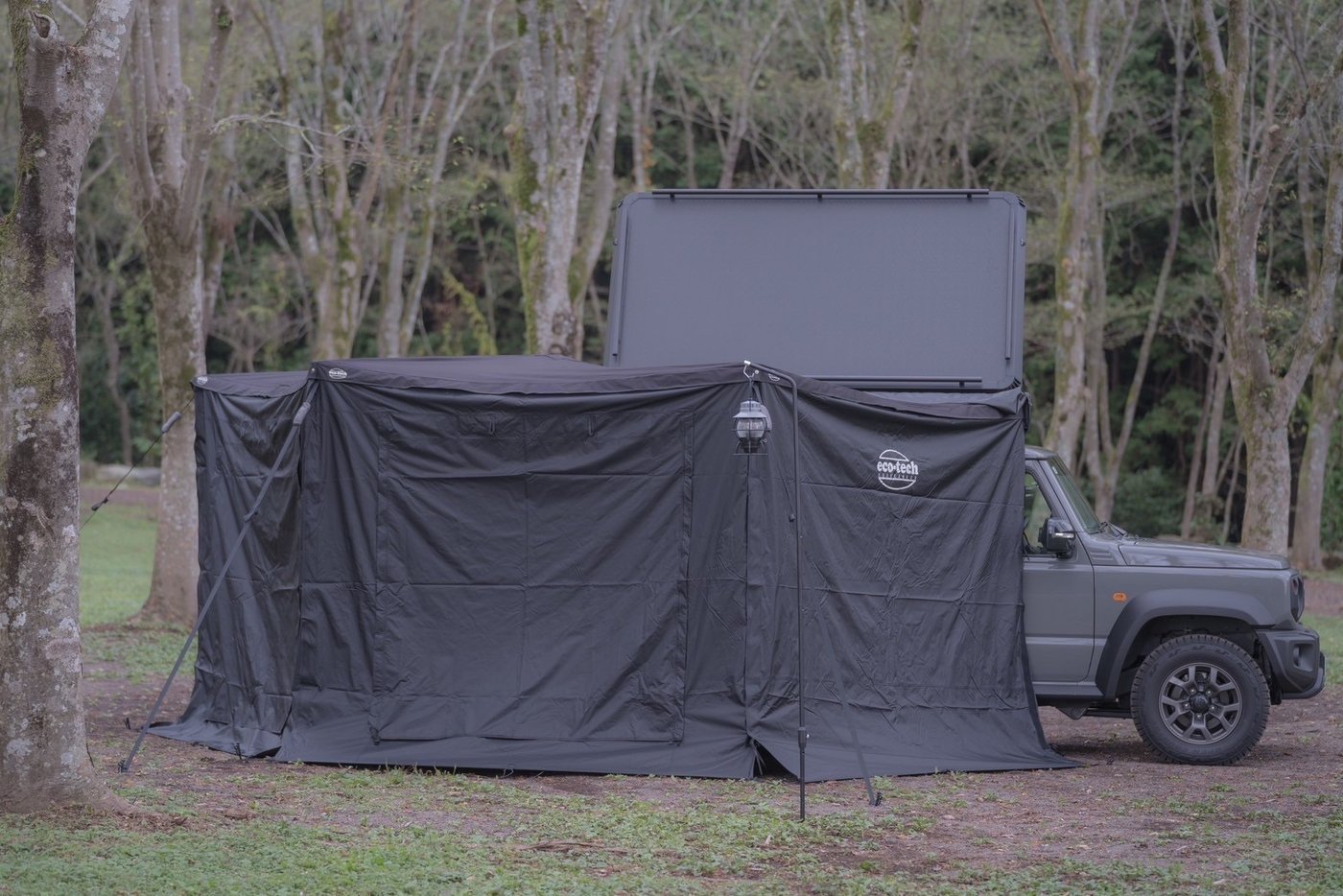
How you set up the awning (the roof you put up on the side of the car) can make the kerosene heater work better. There are two main ways to set up the awning wall.
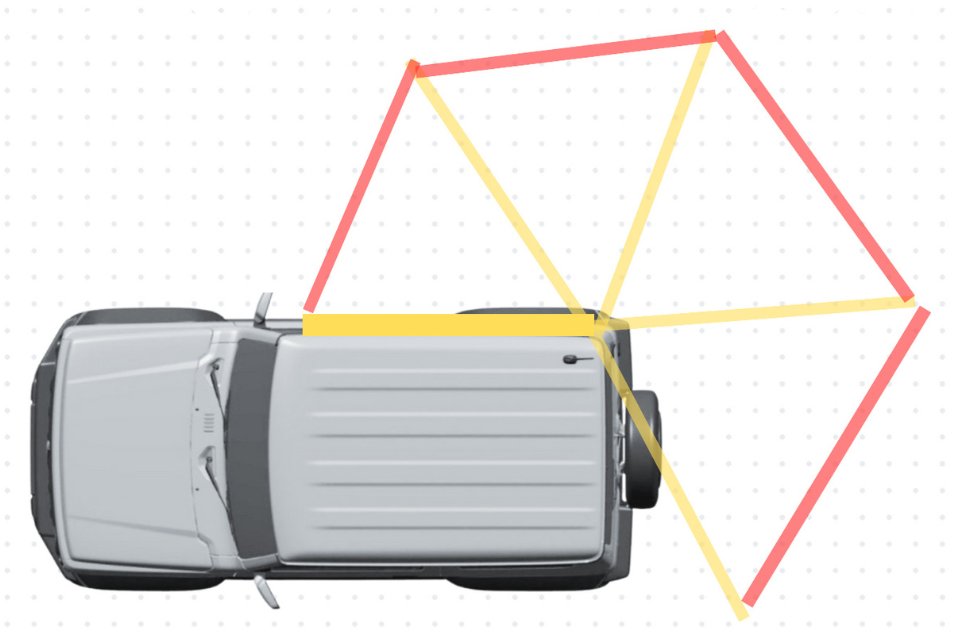
Normal season
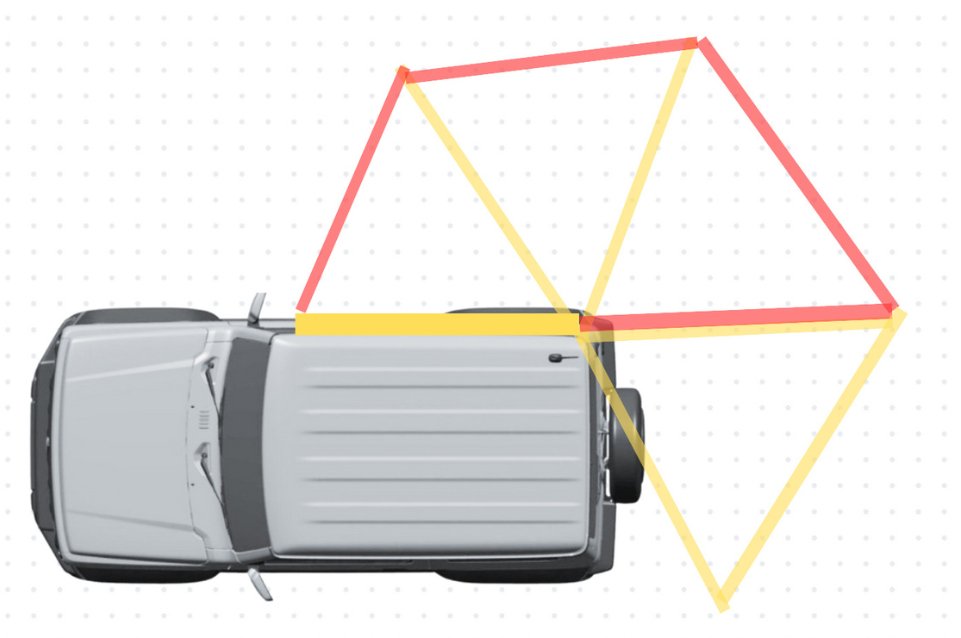
Cold winter
Normal season: the standard setup
This method puts the wall around the whole fan shape of the awning to enclose the entire area. This is the usual setup, and it gives you a large living space.
Cold winter: making the living space smaller on purpose
This method encloses only the section closest to the car with the wall, so the space is deliberately smaller. You can divide it off just by changing which Velcro strips on the awning you use. Less wind gets in and warm air escapes less easily, so the warmth from the kerosene heater spreads more easily.
How do I use the electric blanket?
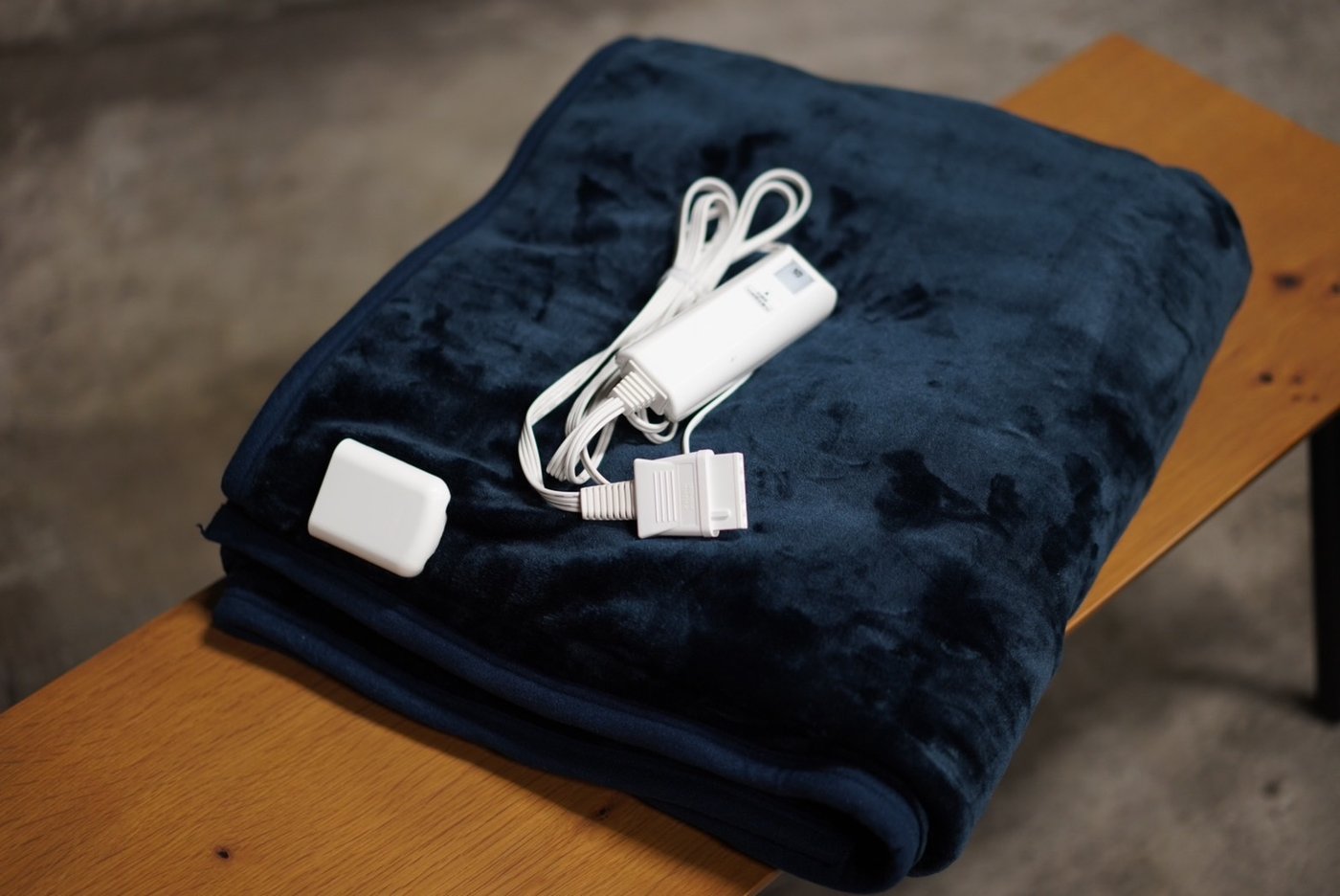
In winter, every vehicle comes with one electric blanket for free. Use it when you sleep, inside the rooftop tent, laid under your sleeping bag.
 Caution
Please use the electric blanket inside the rooftop tent
We lend the electric blanket as bedding. If you use it under the awning, for example spread over a camp chair or as a lap blanket, it will get muddy and the inside of the tent will get dirty too. Please use it only inside the rooftop tent, and when you’re spending time outside, stay warm with the kerosene heater and warm clothing.
 Staff Tips
Do you think a blanket is something you “put over you”? Actually, an electric blanket is much warmer when you lay it underneath you.
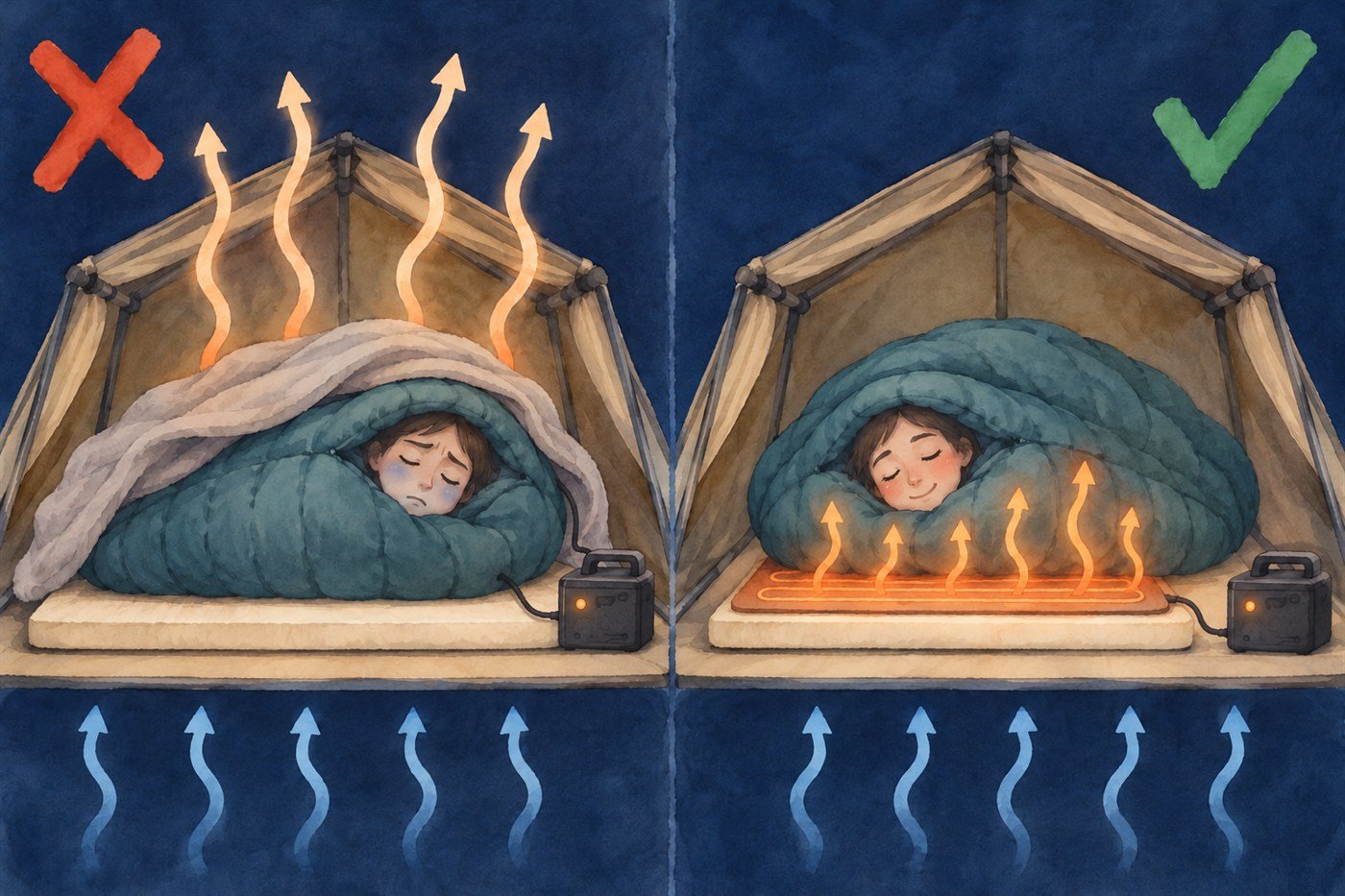
The underside of a sleeping bag gets squashed by your body weight, which weakens its insulation. Even in a rooftop tent, there’s cold outside air below the floor, so your body gets cold from underneath. On top of that, warm air rises, so if you lay the blanket underneath, the heat goes into your body, but if you put it over you, the heat escapes into the tent.
It takes time to warm up
An electric blanket doesn’t get warm the moment you turn it on. If you switch it on inside the tent while you’re warming yourself up by the heater, it’ll be just the right temperature by the time you go to bed.
Adjusting the temperature
You can adjust the warmth from low to high (how you adjust it depends on the type of blanket). We recommend using it on “low” while you sleep. It saves power, and it also helps prevent low-temperature burns, which can happen when the same spot of skin stays in contact with the heat for a long time.
How do I get the portable power station up into the tent?
The portable power station weighs about 12 kg. If you climb about two steps up the ladder, you can reach the tent floor and set it down there. Because it’s heavy, hold it firmly so you don’t drop it, and watch your footing as you lift it up. If there are two of you, it’s safer for one person to climb into the tent first and take it from inside.
How long can I use the electric blanket?
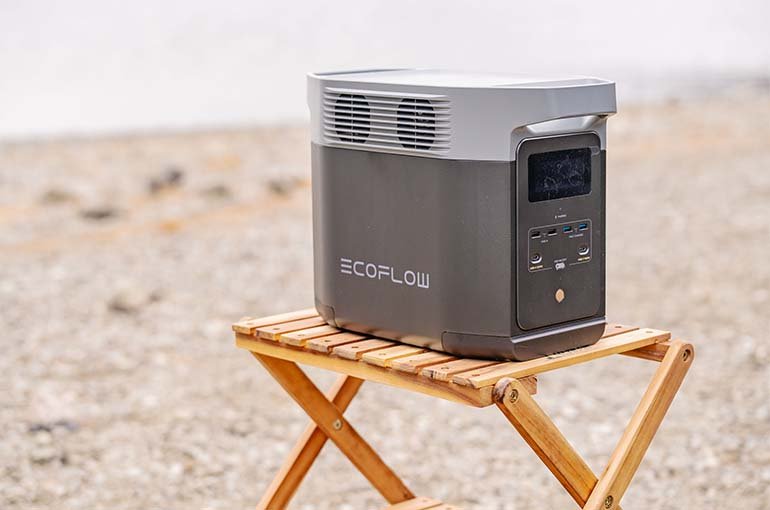
The electric blanket runs on the EcoFlow portable power station (approx. 1,000Wh) that comes with every vehicle. Here’s a rough guide to how fast the battery drains.
| How you use it | How fast the battery drains (rough guide) |
|---|---|
| Low for one night (about 8 hours) | About 20–30% |
| High | About 10% per hour |
Note: These are rough guides and vary with the outside temperature and how you use it.
Staff TipsUnless it’s an extremely cold night, with the electric blanket on “low” plus your sleeping bag, you’re very unlikely to be too cold to sleep. Our staff go winter camping often too, and we’ve never had a problem.
On the other hand, if you fall asleep with it still on “high,” you might wake up in the middle of the night drenched in sweat…
 Note
Worried about running out of power?
- If you include a campsite with a powered site (a pitch with an AC outlet) in your itinerary, you can fully charge the portable power station overnight
- With the Jimny Premium Edition or Jimny Long Trip Edition, it fully recharges in about 1.5 hours of driving (the Jimny Premium Edition color lineup)
How can I stay warm at night?
- If there’s a hot spring (onsen) or public bath nearby, start by warming yourself up thoroughly in the hot spring
- Before bed, warm yourself up by the kerosene heater (use it outdoors and ventilate from time to time). Switch on the electric blanket early at the same time, and it’ll be just the right temperature by the time you go to bed (see “How do I use the electric blanket?”)
- Keep your layers on when you sleep. Wear a beanie (because heat escapes easily from your head) and two pairs of thick socks
Is it OK to come with kids?
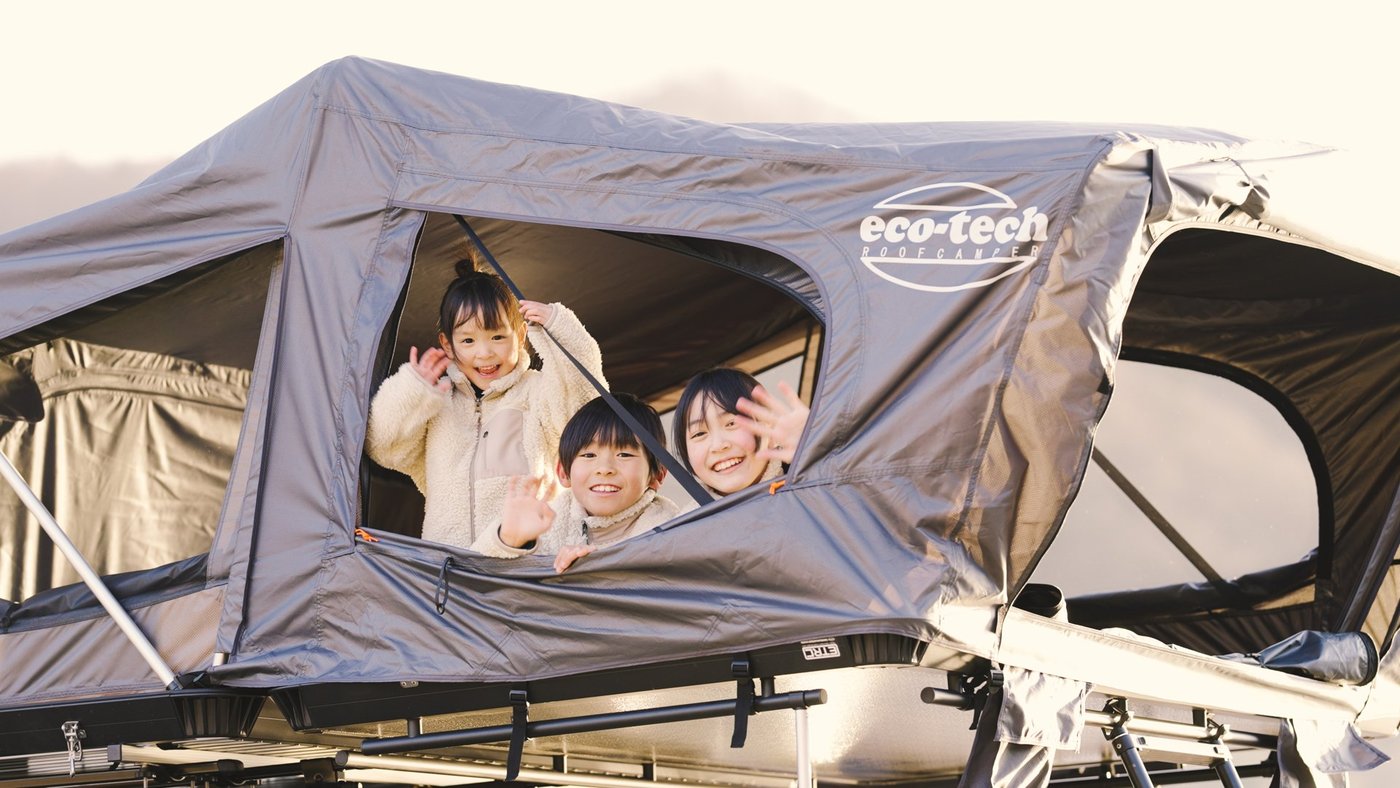
For family trips, we recommend the DELICA D:5. It fits up to 4 adults plus 1 small child.
The heated vest doesn’t come in children’s sizes, so please keep your kids warm with layers, a beanie, gloves, stick-on heat pads and so on.
When you’re using the kerosene heater, please keep an eye on your children so they don’t get too close. An adult should also go with them when they climb up and down the rooftop tent ladder.
If you’re worried about trips to the toilet in the middle of the night, it helps to have everyone go to the toilet before bed and keep a headlamp by your pillow.
Can I drive when it snows?
First, the most important point: CLOUD NINE does not recommend going to ski resorts or snowy mountains (for details, see “Are there places I’m not allowed to go?” below). CLOUD NINE vehicles aren’t made for driving on snowy roads. They’re for enjoying winter camping in areas that don’t get much snow.
That said, on a winter trip it can of course start snowing along the way. But don’t worry. Snow heavy enough for “chain restrictions,” which even cars with studless tires can’t get through, is very rare. Since our cars have studless tires, you’ll be fine in ordinary snow as long as you keep a few key points in mind and drive slowly.
What are studless tires? And what are chain restrictions?
What are studless tires?
They’re winter tires designed so you’re less likely to slip on snowy or icy roads. The rubber doesn’t harden easily even at low temperatures, and the surface has lots of fine grooves that grip snow and ice as you drive. They’re called “studless” because they don’t use metal pins (studs). In snowy parts of Japan, many cars switch to these tires when winter comes.
Snow-day traffic restrictions come in two levels
On Japanese roads, depending on how much snow there is, the following two levels of restrictions may be put in place. They’re shown on electronic road signs and similar displays.
No restrictions
Winter tire restrictions
Chain restrictions
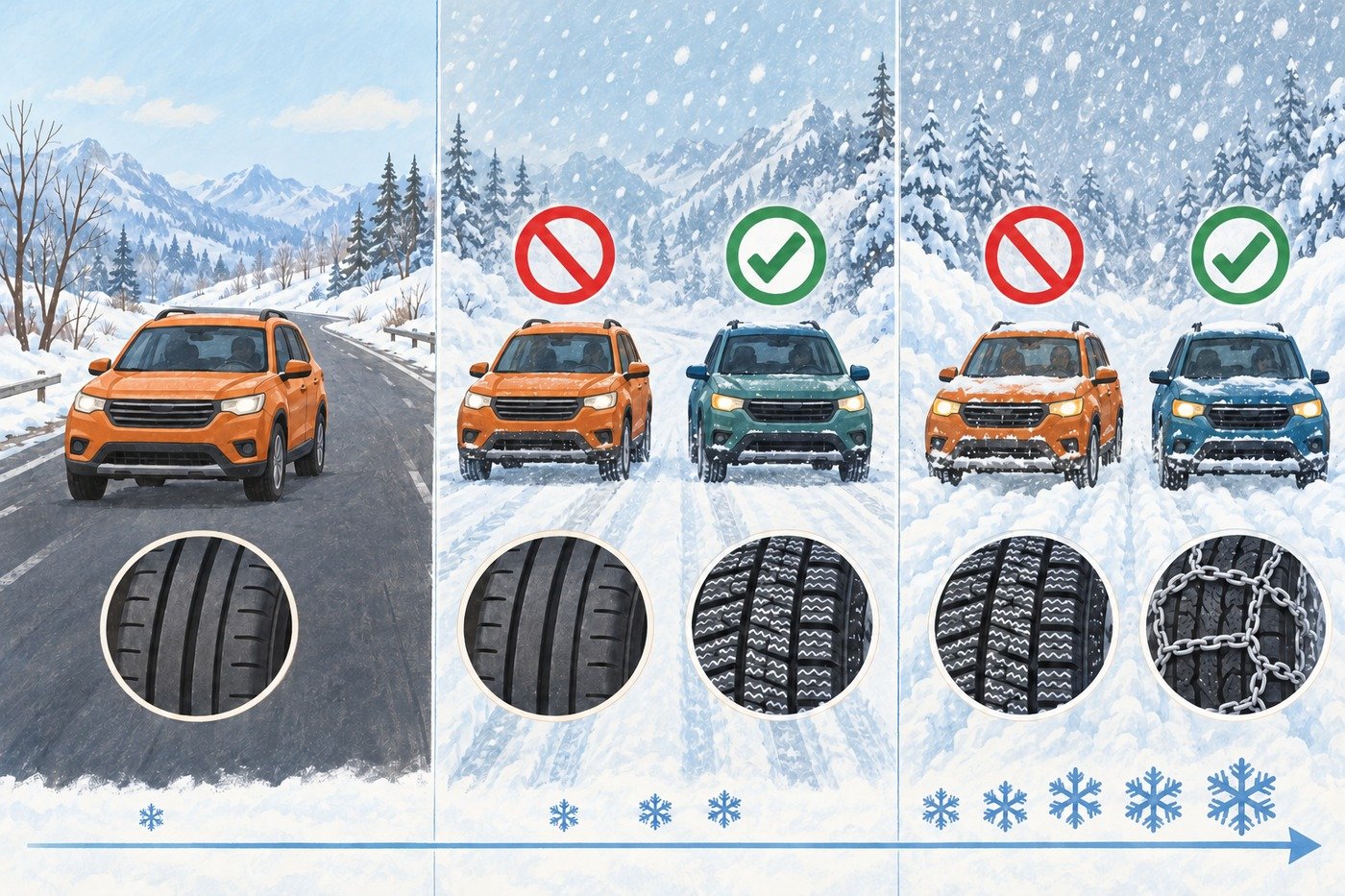
| Restriction | What does it mean? | CLOUD NINE vehicles (December 1 – March 31) |
|---|---|---|
| Winter tire restrictions | Cars with regular tires (summer tires) can’t pass. Only cars with studless tires or chains can pass. These are often put in place on expressways and other roads when it snows | Can pass (because they have studless tires) |
| Chain restrictions | Even with studless tires, you can’t pass without tire chains | Cannot pass (we don’t carry chains, and driving there is also prohibited by our rental terms) |
PointChain restrictions are only put in place on a limited number of sections nationwide, such as steep mountain passes, and only during exceptionally heavy snowfall. If a forecast calls for that kind of heavy snow, don’t push yourself to keep moving. Message us early on Instagram or LINE.
Are there places I’m not allowed to go?
For safety, our rental terms set out the following.
 Rules
What our rental terms set out
- You may not drive on sections under chain restrictions, closed roads, or roads closed for the winter. How chain restrictions work is explained above in “What are studless tires? And what are chain restrictions?”
- If you cause an accident for which you are at fault in an area under a Heavy Snow Warning (including a Heavy Snow Emergency Warning), you will pay the full cost of repairing the car plus the NOC, whichever plan you have (this also applies to single-vehicle accidents with no other party involved). If a Heavy Snow Warning is issued, don’t push yourself to keep driving. Wait somewhere safe until it’s lifted. If you contact us before 16:00, you won’t be charged the late-return fee or overdue fee, even if this makes you late returning the car
Roads high up in the mountains get more snow and ice than those at the foot, and the weather can change suddenly, so CLOUD NINE does not recommend going to ski resorts or snowy mountains. The Mt. Fuji area, for example, has lots of campsites on flat land where you can see snow-capped Mt. Fuji without going to a ski resort. We hope you’ll take your time and enjoy winter scenery while staying on the safe side. For the full rules, please check our Car Rental Terms.
What should I watch out for when driving on snow?
These four points are what matter most.
1. Above all, drive slowly
Even with studless tires, you can still slip on icy roads. Don’t overtrust your tires just because they’re made for winter. Drive slower than usual. Avoid sudden braking and sharp steering, and always brake early and gently.
2. Leave plenty of following distance
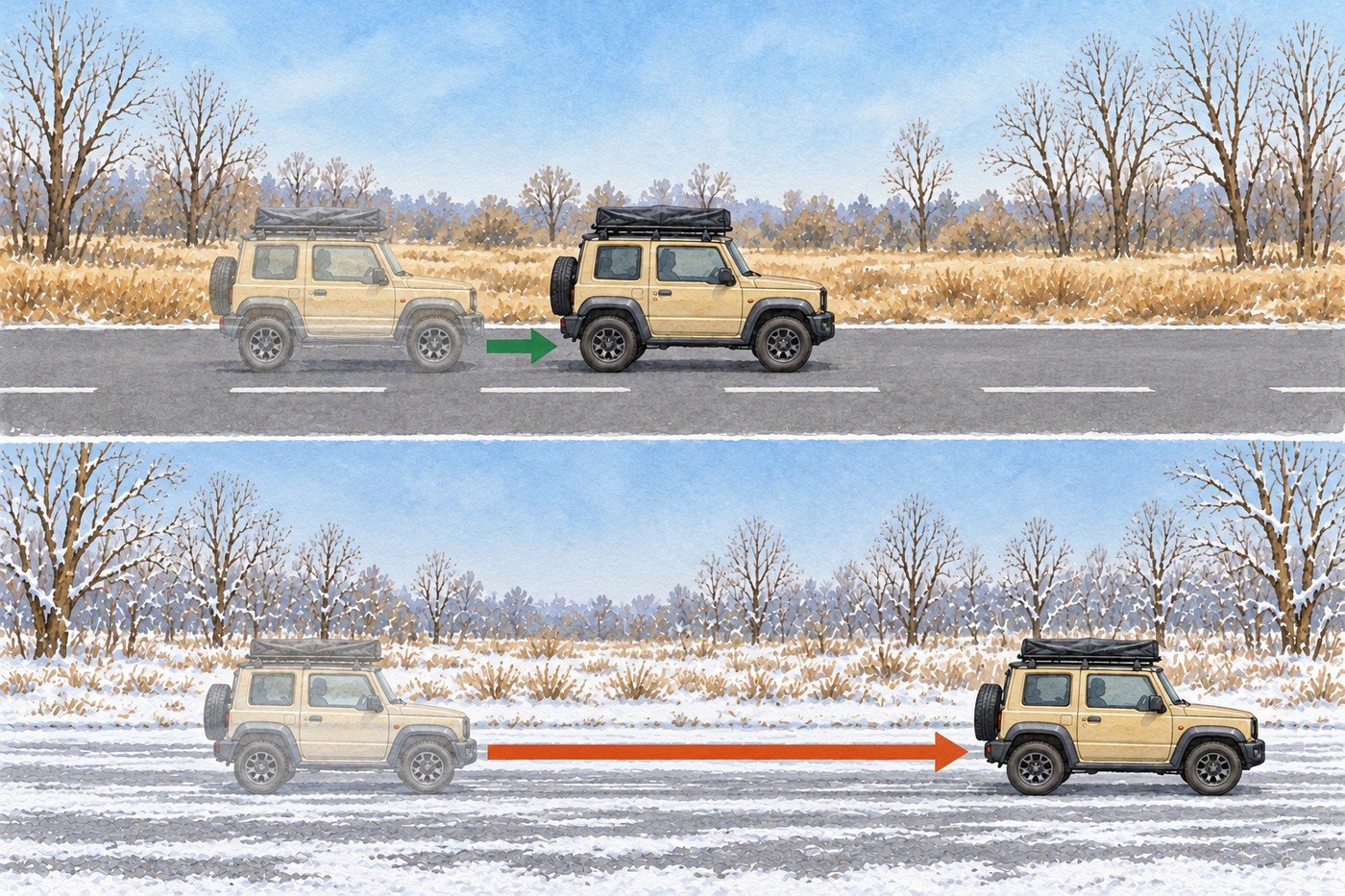
On snowy or icy roads, your stopping distance becomes much longer than usual. Leave more space than usual between you and the car in front. Be especially careful on bridges and in shaded spots in the morning, because it’s hard to tell just by looking whether they’re icy.
3. Switch to 4WD
On snowy or icy roads, switch both the Jimny and the DELICA D:5 to 4WD (how to do this on the Jimny is explained below in “How do I switch the Jimny to 4WD?”). Keep in mind that 4WD helps when starting off and going uphill, but it doesn’t help you stop any sooner.
4. If heavy snow is forecast, leave snowy areas the day before
If there’s a heavy-snow forecast, the safest choice is to leave snowy areas the day before. Moving early, rather than putting it off with “let’s wait one more day and see,” actually keeps your plans on track in the end. You can check for road closures on official sources such as the Japan Road Traffic Information Center (JARTIC) and NEXCO Central Japan’s iHighway (both in Japanese only). If you’re not sure, don’t push yourself. Message us on Instagram or LINE.
How do I switch the Jimny to 4WD?
Next to the driver’s seat
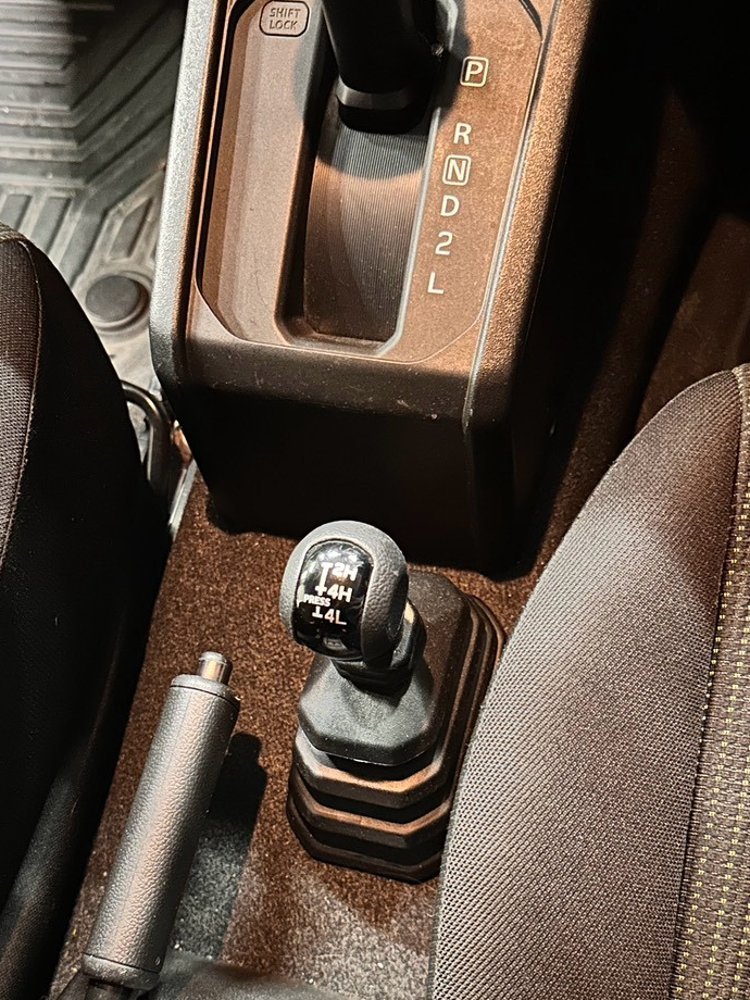
The smaller lever
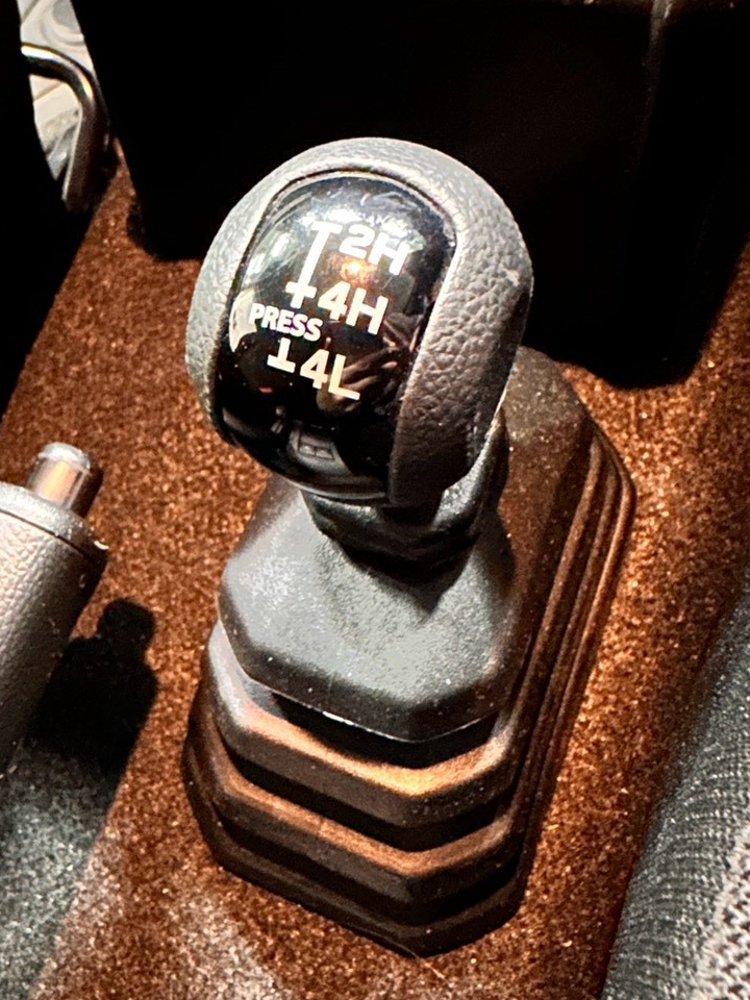
Every CLOUD NINE Jimny is a Jimny SIERRA (JB74). It normally runs in 2WD, and you switch to 4WD only on slippery roads such as snowy roads. You switch using the smaller lever (the transfer lever) next to the driver’s seat.
| Lever position | When to use it | How to switch |
|---|---|---|
| 2H (2WD) | Everyday paved roads | — |
| 4H (4WD) | Slippery roads, such as snowy or icy roads | You can switch while driving straight at 100 km/h or less (no need to stop) |
| 4L (4WD, low range) | Steep uphill slopes and rough roads | Always stop first before switching |
- On snowy winter roads, 4H is basically all you need
- “100 km/h or less” is the condition for switching while driving. It does not mean it’s OK to drive that fast on snowy roads
- Once you’re back on ordinary paved roads with no snow, switch back to 2H
- For details on how to operate it, feel free to ask our staff when you pick up the car
You’ll also find tips for driving on snowy roads in the “First-timer’s guide to snowy roads” on the MyTrip Dashboard, your personal trip page available once you book. If you’re even a little worried, please get in touch with us early.
What happens if heavy snow makes me late for the return?
What if you run into heavy snow on your way back and might not make it in time for the return? We have a system for exactly that. If you contact us before your scheduled return time (16:00), and a Heavy Snow, Storm or Snowstorm Warning (including an Emergency Warning issued by the Japan Meteorological Agency) is in effect in the area along your route back, or your route is closed or under chain restrictions, you won’t be charged any late fees. Once the warning or restriction is lifted, please return the car promptly.
Don’t push yourself to make it back on time. Just contacting us first is what gives you the most peace of mind.
What kind of campsite should I choose in winter?
Many campsites are closed for the winter.
Here are three points to keep in mind when choosing one.
- Campsites with hot springs (onsen) or public baths nearby
- Campsites with powered sites (you can charge the portable power station)
- Campsites at a lower elevation, which are less likely to freeze
Just keeping these three points in mind will make choosing a winter campsite much easier.
CLOUD NINE has a “Recommended Campsite List (PDF).” It also includes campsites with bathing facilities, so please use it when planning your itinerary. You can find the list in your booking confirmation email and on the MyTrip Dashboard.
PointOnce you find a campsite you like, it’s a good idea to contact the campsite directly before booking to check that it isn’t closed for the winter and that powered sites are available.
Warm up at a hot spring first, then spend a relaxing night with the heater and the electric blanket. Once you get into this routine, winter camping becomes much more comfortable.
What should I bring?
CLOUD NINE vehicles come fully equipped with winter gear, but please bring your own clothing.
The basics of what to wear: layering
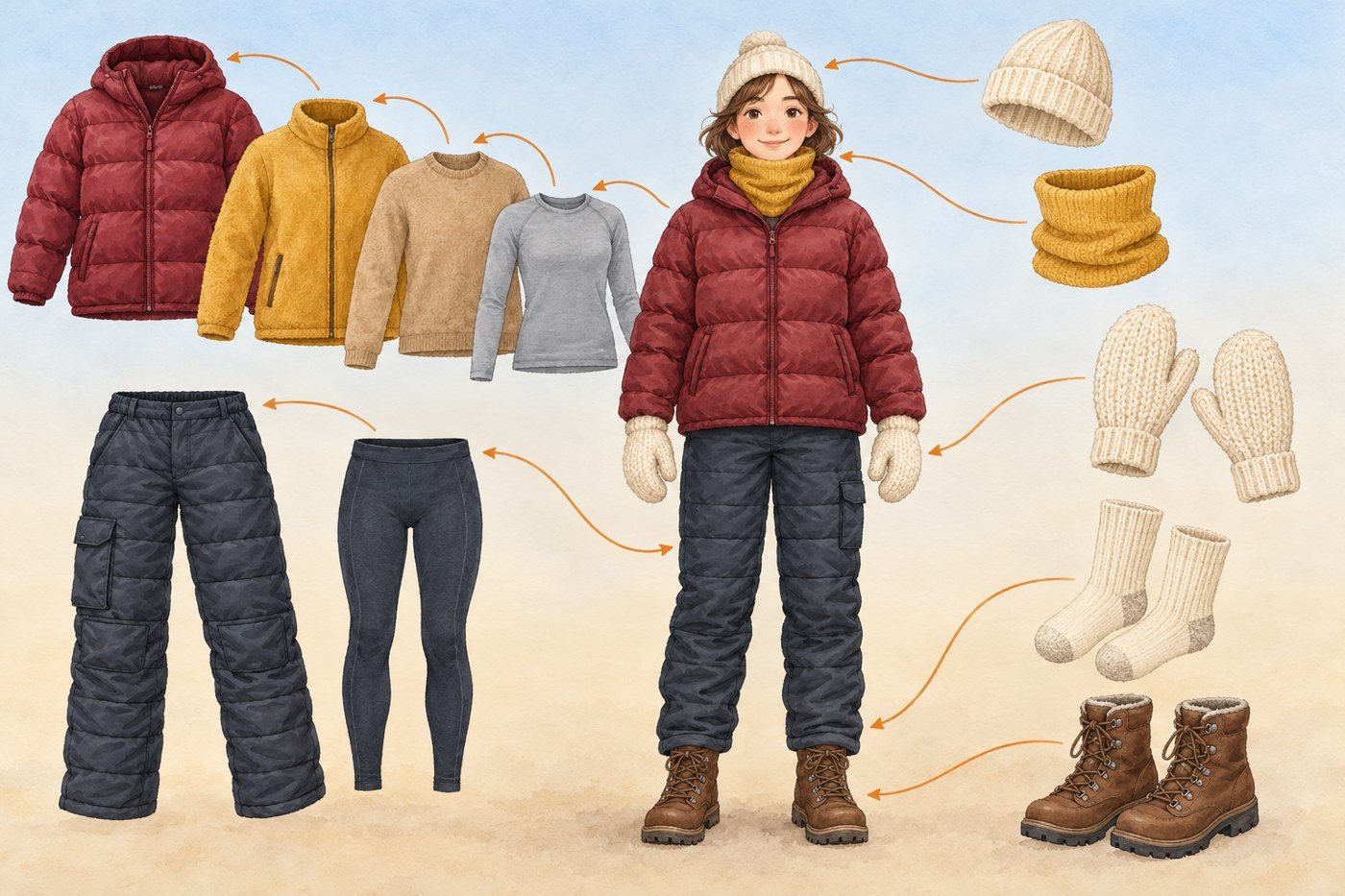
At night, you’ll spend a lot of time sitting still under the awning. Your body gets colder than it does during the day when you’re walking around, so at night, a good rule of thumb is “one more layer than you think you need”.
Upper body (3–4 layers)
- Base layer — Synthetic or wool fabrics that dry quickly even when you sweat are recommended. Cotton doesn’t dry easily once it absorbs sweat, and it makes your body cold. It’s also a good idea to get thermal base layers available in your own country (such as UNIQLO HEATTECH) before coming to Japan
- Long-sleeved shirt — Thin wool, for example
- Mid layer, such as a thick fleece
- Warm outer layer, such as a down jacket
Lower body (2 layers)
- Thermal leggings or tights worn directly against your skin
- Pants that block the wind (insulated or windproof) — Cotton pants such as jeans make your body cold easily, so avoid them at night
Accessories (neck, hands and feet)
- Gloves — Cold fingertips alone can make you feel miserable. There’s also a lot of hands-on work, like refueling the heater, so please be sure to bring some
- Beanie — It’s fine to keep it on while you sleep
- Neck warmer — Covering your neck helps keep your body heat from escaping
- Thick socks — 2–3 pairs, including spares, will give you peace of mind
- Warm, non-slip shoes — Winter boots, for example. The ground can be icy in the morning
You can take layers off or put them on one at a time to match the temperature. If you go into the night still sweaty, your body gets cold easily, so we recommend changing into dry clothes once you arrive at the campsite.
Even if you’re dressed lightly while sightseeing, it gets cold fast once the sun goes down, so it’s a good idea to keep your outerwear in the car for the evening. Combine this with CLOUD NINE’s winter gear, and you’ll stay warm through the night.
What are stick-on heat pads?
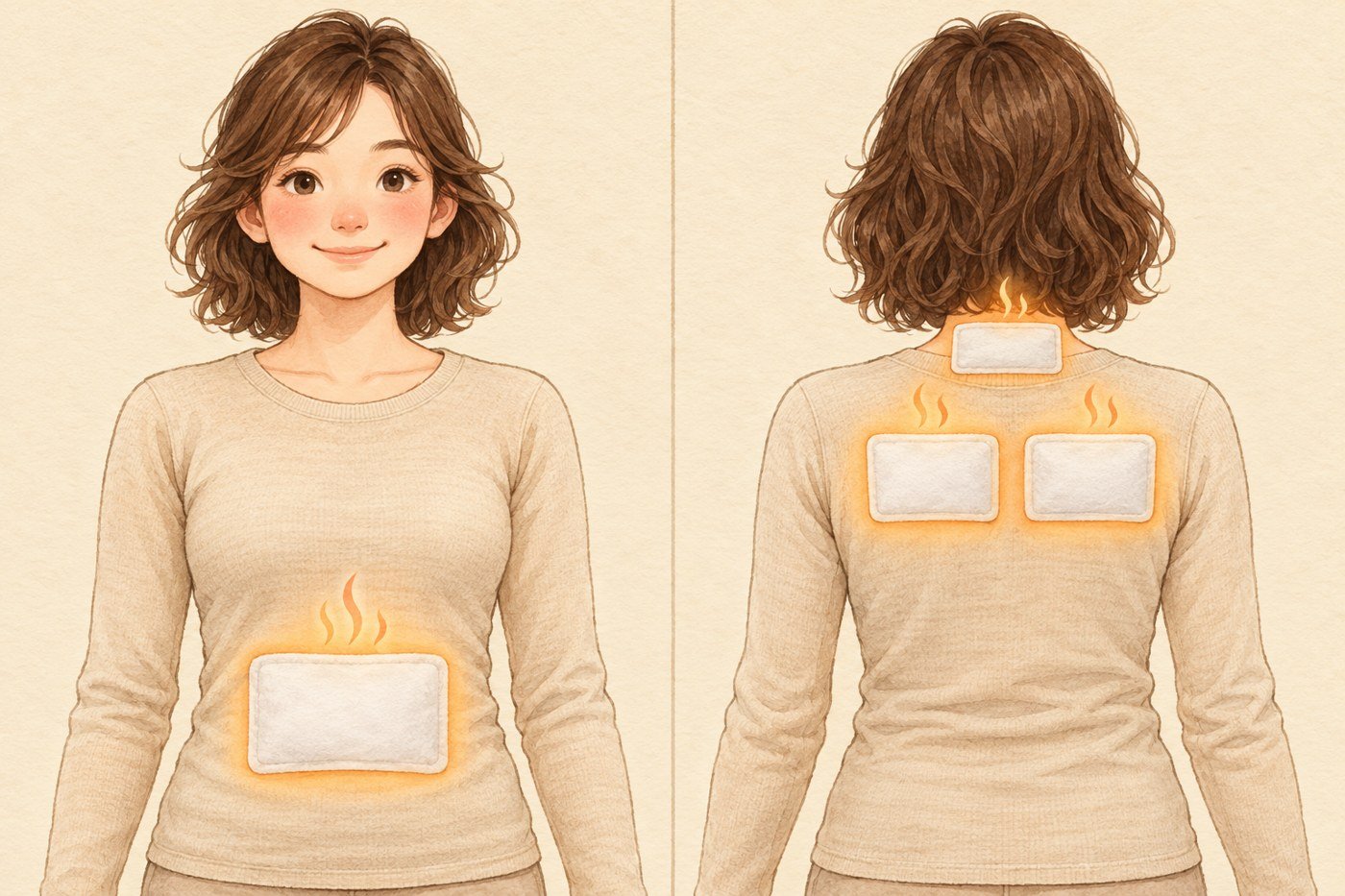
Stick-on heat pads (called haru kairo in Japanese) are a winter staple in Japan, and we highly recommend giving them a try. They’re disposable warmers that heat up on their own once you take them out of the package. They don’t use electricity or fire.
Where can I buy them?
You can buy them at convenience stores and drugstores, and at supermarkets too. On your way to the campsite, it’s a good idea to pick up a supply while you’re shopping for food.
Where should I stick them?
Stick them around your stomach, shoulders and neck, and your whole body will feel toasty. Don’t stick them directly on your skin; put them on over your base layer.
CautionTake them off before you go to sleep
If heat pads stay on the same spot for a long time, they can cause low-temperature burns. Take them off when you go to sleep.
Can I buy warm clothing in Japan?
- If you want to keep using it after you go home → outdoor gear stores
If you’re going to buy something anyway, get something you can keep using back in your home country. We recommend high-quality, long-lasting brands such as THE NORTH FACE and mont-bell. - If it’s probably just for this trip → WORKMAN
It may not be well known outside Japan, but it’s a brand that’s like an outdoor version of UNIQLO. You’ll find practical, functional warm clothing at affordable prices.
Outdoor gear stores
There are lots of outdoor gear stores near Mt. Fuji. Here are a few examples.
- SWEN Gotemba
- STANDARD point (Fujikawaguchiko)
There’s also L-Breath Olinas Kinshicho just a 3-minute walk from CLOUD NINE CAMPING JAPAN.
WORKMAN
WORKMAN has stores all over Japan. The nearest stations to CLOUD NINE CAMPING JAPAN are Kinshicho and Oshiage (Tokyo Skytree), and there are stores near both, so stopping by on your way to us is a good option too.
- Oshiage: Workman Colors Tokyo Solamachi
- Kinshicho: #Workman Joshi Arcakit Kinshicho
NoteThe name includes “Joshi” (Japanese for “women”), but it isn’t a women-only store. It carries both men’s and women’s clothing, so don’t worry.
There are also stores near Mt. Fuji, such as WORKMAN Fujiyoshida Matsuyama.
For all of these stores, please check opening hours and closing days on their official websites before you go.
Frequently Asked Questions
Q. Is winter camping cold?
A. Everyone feels the cold differently, so it’s hard to give one answer. In January, the coldest month, even our Japanese staff find it pretty cold. Still, if you’re well prepared for the cold, you can enjoy your time without stress. Winter has little rain, and the crisp, clear air makes the starry skies beautiful. That’s what makes it special. If you’re worried about the cold, adding a heated vest (¥500 per day, excl. tax) will keep you even warmer.
Q. What temperature are the sleeping bags rated for?
A. They’re Coleman sleeping bags, and the manufacturer’s stated comfort temperature is −5°C. To be honest, though, many people find it cold in midwinter without an electric blanket. We recommend laying the electric blanket under your sleeping bag.
Q. How much is the heated vest?
A. You can rent one for ¥500 per day (excl. tax). It comes with a 20,000mAh mobile battery and is available in sizes S, M, L, XL and 2XL (no children’s sizes). It can’t be booked online, so please ask our staff on the day of rental (for details, see “What’s a heated vest?”).
Q. Is there a heater I can use inside the tent?
A. No, there isn’t. Every vehicle comes with a kerosene heater in winter, but using it in an enclosed space produces carbon monoxide, so it cannot be used inside the rooftop tent or inside the car. Use it outside the tent, under the awning, to warm yourself up before bed. Inside the tent, plug the electric blanket into the portable power station and lay it under your sleeping bag.
Q. What should I do if the heater runs out of kerosene?
A. Take the heater itself to a nearby gas station and tell the staff “灯油 (TOUYU),” and they’ll fill it up for you. If you’d like to have extra on hand in advance, we also offer an extra 10 L of kerosene as an option (¥1,800 excl. tax; please ask on the day of rental).
Q. How many electric blankets can I borrow?
A. One per vehicle, for both the DELICA D:5 and the Jimny. Because you lay it under your sleeping bag, one is enough to keep you warm.
Q. Is the portable power station enough in winter?
A. Every vehicle comes with an EcoFlow of approx. 1,000Wh, but in winter it drains faster because of the electric blanket (for a rough guide, see the table in “How long can I use the electric blanket?”). For peace of mind, include a campsite with powered sites in your itinerary, or choose the Jimny Premium Edition or Jimny Long Trip Edition, which fully recharge in about 1.5 hours of driving.
Q. When are studless tires fitted?
A. We switch all vehicles to studless tires by December 1, and from April we gradually change them back to regular tires. That means December 1 to March 31 is the period when all vehicles are guaranteed to have studless tires.
Q. Do you carry chains or a snow brush?
A. No, we don’t. CLOUD NINE vehicles are meant for enjoying camping in areas that don’t get much snow, not for going to areas with heavy snowfall or snowy mountains. If snow piles up on the car, brush it off with your gloved hands or similar. For the rules on which roads you can drive on, please check “Are there places I’m not allowed to go?”.
Q. Can I go to ski resorts, or to snowy mountains and mountain passes?
A. CLOUD NINE does not recommend it. This is because roads high up in the mountains get more snow and ice than those at the foot, and the weather can change suddenly. Please note that under our rental terms, you may not drive on sections under chain restrictions, closed roads, or roads closed for the winter. Also, if you cause an accident for which you are at fault in an area under a Heavy Snow Warning (including a Heavy Snow Emergency Warning), you will pay the full cost of repairing the car plus the NOC, whichever plan you have (for details, see “Are there places I’m not allowed to go?”). The Mt. Fuji area, for example, has lots of campsites on flat land with views of snow-capped Mt. Fuji.
Q. What should I do if it starts snowing during my trip?
A. There’s no need to worry. That’s exactly why the cars have studless tires. Just remember to drive more slowly than usual. However, if heavy snow is forecast, the safest choice is to leave snowy areas the day before. If you’re not sure, message us on Instagram or LINE.
Q. What happens if heavy snow might make me late returning the car?
A. If you contact us before your scheduled return time (16:00), and a Heavy Snow, Storm or Snowstorm Warning is in effect in the area along your route back, or your route is closed or under chain restrictions, you won’t be charged any late fees (Heavy Rain Warnings are not covered). Don’t push yourself. Just contact us first.
Q. What should I do on rainy days or during a cold snap?
A. There aren’t many rainy days in winter, but if you do run into rain or a strong cold snap, we recommend not pushing yourself and switching to a sightseeing-focused trip, using cabins, Airbnb or hotels. Getting wet in the rain when your body is already cold makes it easy to get sick.
Summary and how to book
Winter is a truly special season: the air is crisp and clear, Mt. Fuji looks its most beautiful, and campsites are less crowded. It would be a shame to give up just because “it’s too cold.” With CLOUD NINE’s winter gear and the tips in this article, you can enjoy scenery and peaceful moments that only winter can offer.
- Nights get really cold, so don’t forget to layer up and to “get the heater and the electric blanket ready before bed”
- Use the heater under the awning and don’t forget to ventilate. Lay the electric blanket under your sleeping bag and watch out for low-temperature burns
- All vehicles have studless tires from December 1 to March 31. We don’t carry chains or snow brushes, so check which roads you can drive on in “Are there places I’m not allowed to go?”. You can fully enjoy snowy Mt. Fuji even from campsites on flat land
At CLOUD NINE, our vision is to become “Japan’s kindest rental car company.” Even if this is your first time winter camping, if you have any concerns, feel free to message us on Instagram or LINE (you can exchange contact details with our staff on the day of rental). Any language is fine. We’ll reply as soon as we can.